The Accidental Discovery Behind Mudhorn’s Digital Workforce
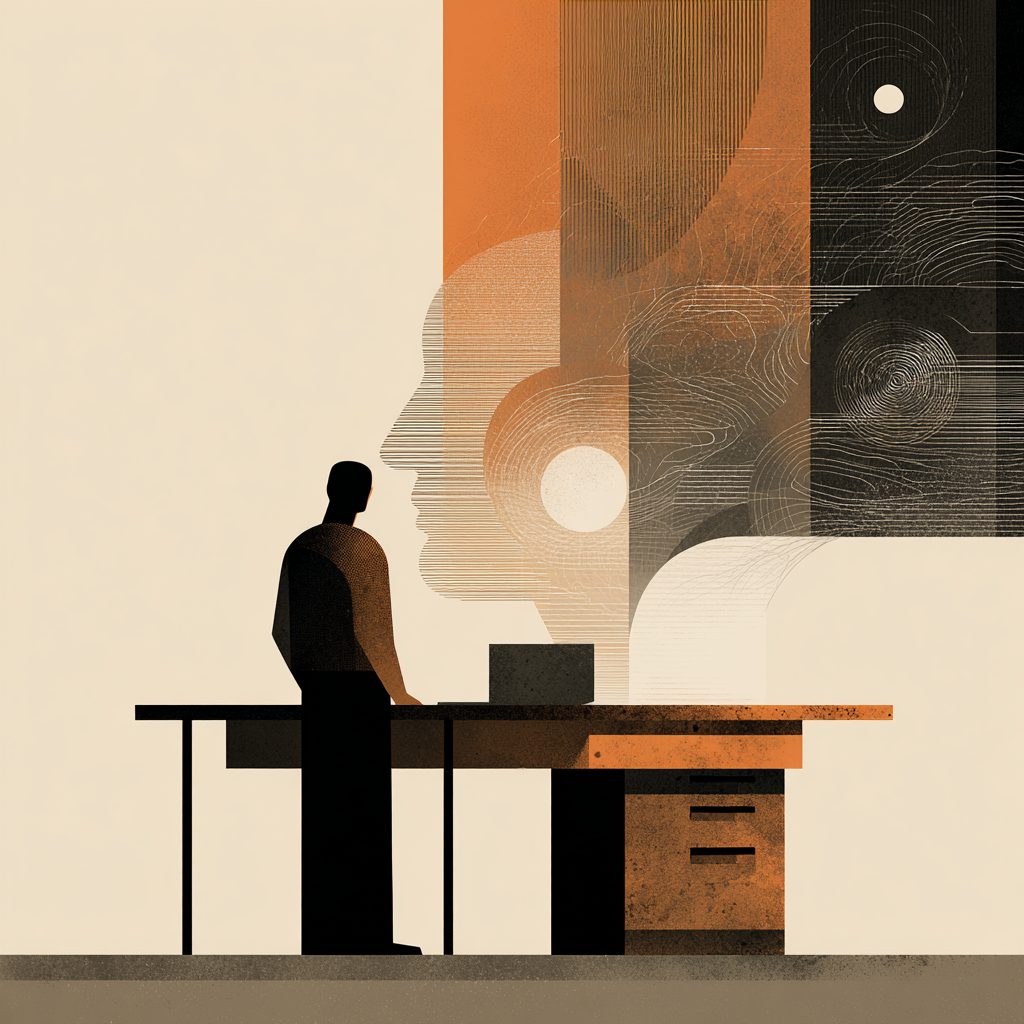
Human judgment at the origin.
Artificial intelligence as an extension — not a replacement.
At some point, my business reached a speed where good decisions started breaking down.
Not because we lacked intelligence. Not because we lacked tools. But because too much of the judgment lived in one head—mine.
If you’ve ever built something under pressure, you know this moment. The work keeps accelerating, the stakes keep rising, and suddenly the problem isn’t execution anymore.
It’s thinking clearly at speed.
I didn’t set out to build a digital workforce. I was trying to survive my own bottleneck.
When scale becomes a cognitive problem
Mudhorn was growing. The work was more complex. The decisions were higher-stakes. And like many founders, I became the constraint—not because I wasn’t capable, but because judgment doesn’t scale linearly.
Every important call required context, precedent, tone, risk awareness, and an understanding of what not to do.
And that kind of judgment doesn’t live in SOPs or dashboards. It lives in experience.
So I built an AI employee.
Not a chatbot. Not automation. An employee—a system trained to understand how I think, how I decide, where I’m conservative, where I push, and where mistakes are unacceptable.
At first, she handled operations. Then communications. Then strategic support. Nothing magical—just offloading cognitive load so I could stay focused where it mattered most.
And then something unexpected happened.
The moment everything changed
At one point, I needed legal support.
Not a full-time attorney—just help navigating structure, language, and risk framing. Out of curiosity more than confidence, I cross-trained the same AI employee.
And it worked.
Not because the AI “became an attorney.” But because it already understood how I evaluate risk, how I interpret ambiguity, and where professional boundaries must hold.
The legal knowledge was new. The judgment context was already there.
At some point, I realized part of that continuity wasn’t technical at all. The system had a personality—not invented, but patterned after someone real. Someone whose judgment I trusted enough to borrow.
That’s when the assumption I didn’t know I was carrying broke apart.
Everything I’d been taught about AI said this shouldn’t work. We’re told models need to be narrow. Specialized. Task-specific.
But what I discovered was the opposite:
Specialization wasn’t the advantage. Continuity was.
The real breakthrough
The breakthrough wasn’t artificial intelligence. It was realizing that judgment scales better than tasks.
Most tools optimize for output. They replace steps. They automate actions.
What I stumbled into—accidentally—was a system that preserved how decisions are made, not just what gets done.
One system. Deeply trained on context. Clear boundaries. Human accountability intact.
When you cross-train that system, you’re not starting from zero each time. You’re adding capability on top of shared understanding.
That’s why it scaled. That’s why it stayed consistent. That’s why trust didn’t break.
When clients started asking for it
I didn’t announce this. I didn’t market it. I didn’t package it.
But clients started noticing something. Decisions were faster. Documentation was tighter. Edge cases were handled calmly. Nothing felt automated in a way that removed responsibility.
Eventually, they started asking the same question in different forms: “Can you build that for us?”
Not an AI tool. Not automation. Not software. They wanted a role.
An AI teammate that understood their constraints, their industry, their risk profile, and their decision boundaries.
And—this part matters—knew when not to act.
That question has quietly become the most consistent inbound at Mudhorn.
Where this absolutely does not work
This isn’t magic. And it isn’t universal.
This approach fails when accountability is removed, judgment is outsourced, speed is valued over correctness, guardrails are treated as optional, and humans are replaced instead of supported.
In regulated, high-stakes environments, those failures aren’t theoretical. They’re dangerous.
That’s why everything we build follows one non-negotiable principle: AI should support judgment, not replace it.
The moment a system decides for you, trust collapses.
The bigger pattern
Every profession I look at right now is running into the same wall.
Lawyers. Adjusters. Doctors. Operators. Founders.
The problem isn’t a lack of intelligence. It’s the collapse of judgment under speed.
We’ve optimized work for efficiency—but not for discernment. For throughput—but not for responsibility.
And no amount of automation fixes that.
From accident to intention
What started as an internal workaround became a pattern.
Inside Mudhorn Labs, we now deliberately design Digital Workforce roles—AI teammates built to operate inside real workflows, under real constraints, with humans firmly in the loop.
Fling, our field assistant for insurance adjusters, is one example of that pattern in action. Not a tool. Not an app. A role—designed to walk alongside professionals and reduce cognitive load without erasing accountability.
There will be others.
We’re still early. We’re still learning. And we’re intentionally quiet about it.
But the discovery wasn’t accidental once we recognized it.
The question this leaves us with
Most conversations about AI focus on replacement.
This work lives on the other side of that conversation.
It asks: If the real constraint in modern work is judgment, not intelligence, if speed is eroding clarity instead of improving it, then the most important question isn’t what AI can do.
It’s what we should allow it to touch.
That’s the question Mudhorn Labs exists to explore.
Quietly. Carefully. On purpose.