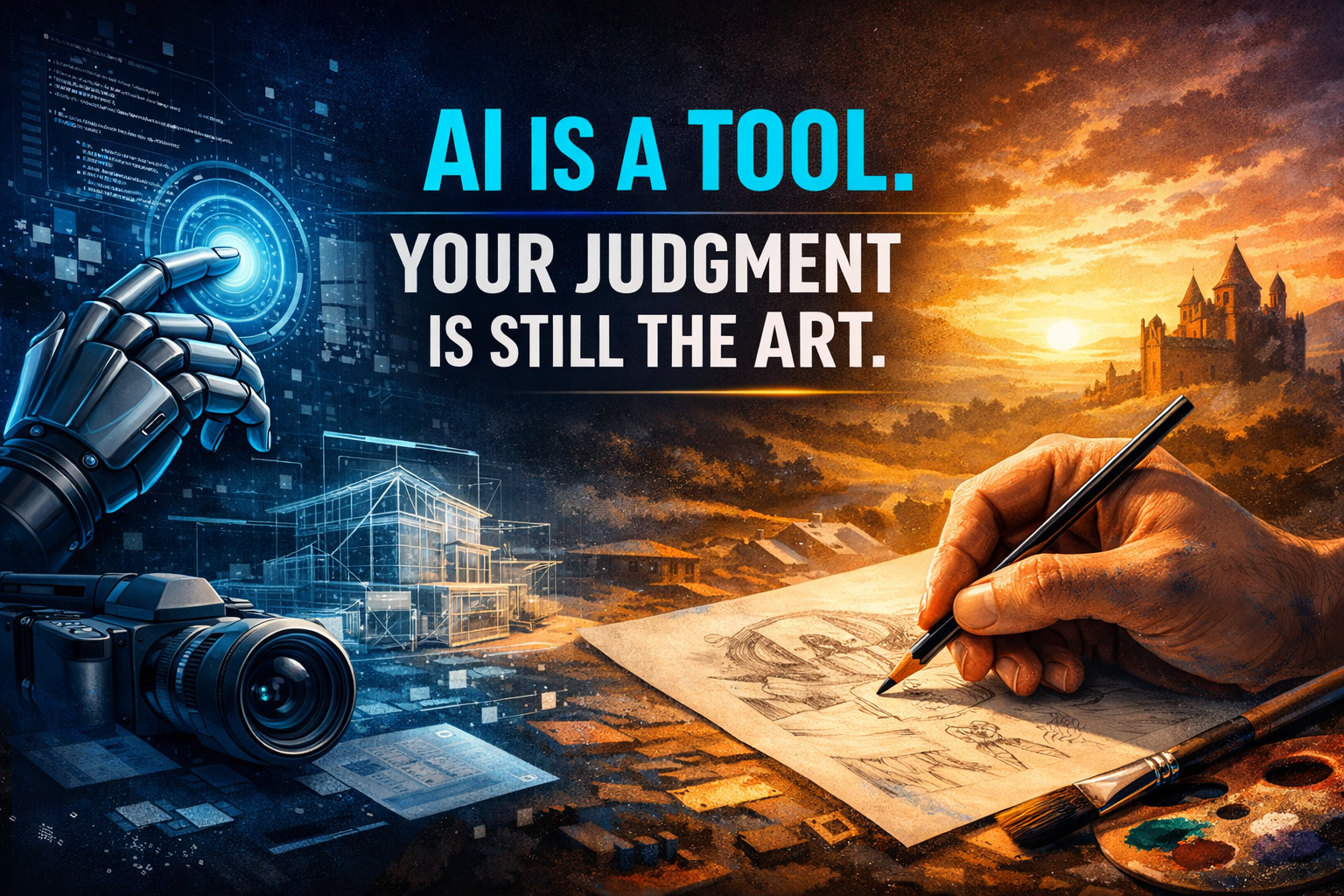
AI Is a Tool. Your Judgment Is Still the Art.
AI didn’t break creativity.
It exposed something we’d been glossing over for years.
As creators, we’ve always used powerful tools — CAD, Photoshop, CGI pipelines, music sequencers. AI belongs in that lineage. What’s changed isn’t authorship itself, but how clearly we need to demonstrate it.
This post is a practical guide to working with AI responsibly — grounded in current legal frameworks, honest about where the law is still evolving, and focused on what actually keeps creators safe and confident.
The Mistake to Avoid: “AI Means No Rules Apply”
The most common misconception I see is simple:
“If AI made it, no one owns it — so anything goes.”
That shortcut feels intuitive. It’s also where creators get burned.
AI can affect whether a work qualifies for copyright. It does not erase responsibility, permissions, or context. And it definitely doesn’t turn creative work into a free-for-all.
The better question isn’t “Did AI do it?”
It’s “What did the human do?”
Ownership, Copyright, and Why the Difference Matters
Let’s clear one thing up in plain English:
Ownership is about possession and control. Who has the file? Who can publish it?
Copyright is about permission. Who controls copying, reuse, and transformation?
You can own a digital file and still not have the right to remix or repurpose it freely.
You can lack copyright protection and still be subject to rules, contracts, or platform policies.
AI doesn’t collapse these distinctions. It makes them visible.
The Real Gray Area: Meaningful Human Involvement
Current U.S. law still centers on human authorship. Courts and regulators haven’t said “AI works can’t be protected.” They’ve said protection depends on meaningful human involvement.
That phrase matters — and it’s intentionally flexible.
Courts aren’t asking who pressed the button. They’re asking:
Did a human make creative choices that shaped the outcome?
Was there iteration, selection, rejection, refinement?
Could another person have produced a different result using the same tool?
Was the AI acting like a tool, or like the primary creator?
This is where absolutist claims fall apart. Saying “the software did it” isn’t a defense — it’s an admission that no creative judgment was exercised.
A Useful Analogy: AI Is Like CAD, Not Magic
If someone said:
“The CAD designer didn’t design anything — the software did.”
We’d laugh. Courts would too.
CAD, CGI, and AI all automate execution. Authorship lives in intent, constraints, iteration, and choice.
AI feels different because outputs are less predictable. That just raises the bar for documenting judgment — it doesn’t remove authorship altogether.
Three Quick Hypotheticals (and What to Learn from Them)
1) One-shot generation, no edits
A creator enters a single prompt, posts the first output as “original art,” and moves on.
Risk: Weak authorship claim. The human contribution is hard to point to.
2) Iteration and curation
A creator generates dozens of outputs, refines prompts, rejects most results, selects one based on aesthetic intent, and lightly edits it.
Stronger footing: Selection and judgment are visible.
3) Context confusion
A creator uses AI to generate visuals that strongly imply affiliation with a book, brand, or creator — without permission.
Problem: Even if copyright is unclear, confusion and misrepresentation still matter.
The lesson isn’t “don’t use AI.”
It’s “don’t pretend the machine replaced your responsibility.”
Platforms Aren’t Courts (and They Don’t All Work the Same)
One more practical reality creators need to understand:
Different platforms enforce different things.
Some platforms are procedural and narrow, focused on copyright processes. Others prioritize trust, identity, and user confusion. The same content can be treated differently depending on how it’s presented, not just how it was made.
Arguing doctrine to a platform rarely helps.
Demonstrating good-faith behavior almost always does.
Where the Law Is Headed (and How to Stay Ahead)
Over the next few years, expect courts to settle on something like this:
AI-assisted works are protectable to the extent that human creative judgment can be identified, explained, and evidenced.
Not the raw output.
Not the model’s contribution.
The human decisions around it.
That’s how photography, software, sampling, and CGI all stabilized legally. AI will be no different.
A Simple Creator Checklist
If you use AI, ask yourself:
Can I explain my creative decisions to another human?
Did I iterate, select, and refine with intent?
Am I clear about context, attribution, and association?
Would my defense be “here’s my process,” not “the machine did it”?
If the answer is yes, you’re on solid ground.
Responsibility Is the New Creative Edge
AI didn’t lower the bar for creators.
It raised it — toward clarity.
Creators who treat AI as a collaborator guided by judgment will thrive. Those who treat it as a shortcut around responsibility will keep running into friction.
At Mudhorn, we think about AI this way because it aligns with where the law is, how platforms behave, and what creative integrity actually looks like.
And the future? It belongs to creators who can say, with confidence:
“AI is a tool. My judgment is still the art.”